
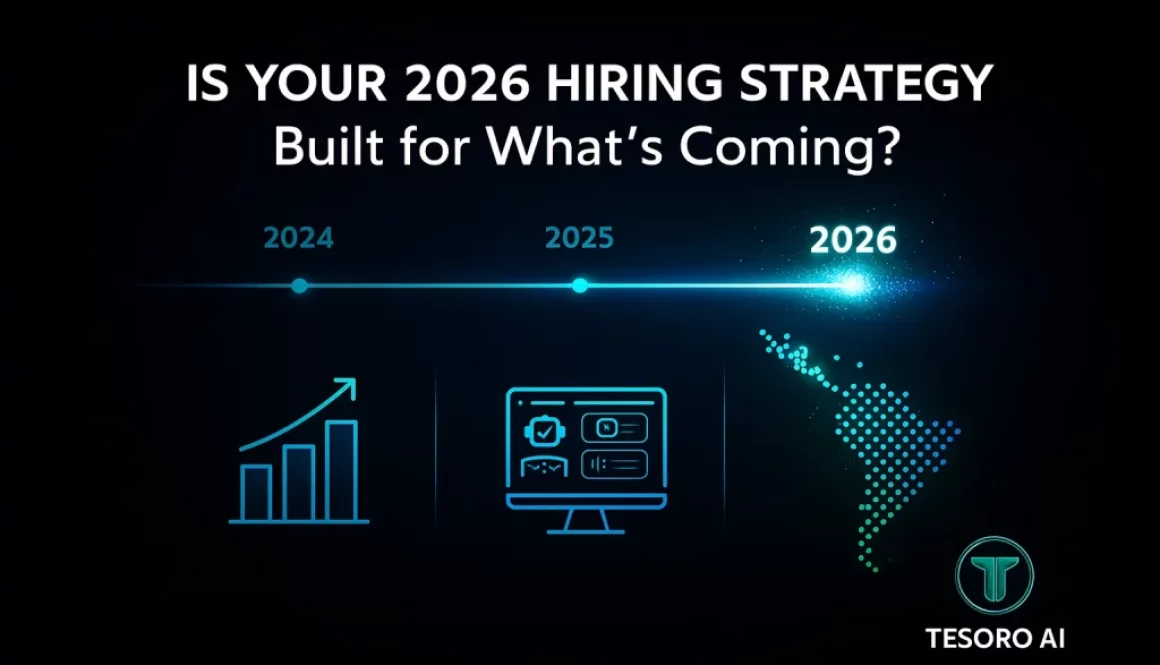
3 Predictions for AI Talent & Hiring in 2026
1. The AI/ML Talent Demand Surge Will Continue — Across All Industries
By 2026, demand for AI and ML professionals won’t just be confined to “tech companies” — it will be baked into companies across finance, healthcare, manufacturing, retail, climate tech, and more.
- Even today, the supply-demand imbalance is already severe: recent industry data shows that globally, demand for AI talent outstrips supply by roughly 3.2 to 1, with over 1.6 million open positions but only about 518,000 qualified candidates.
- Moreover, in 2024 nearly one in four new tech-job postings explicitly required AI or ML skills — roughly double the share from just two years prior.
- As companies across sectors double down on AI-powered automation, insights, and compe-titive advantage, this demand will push further upward in 2026.
Implications for hiring leaders and CTOs:
- Expect a highly competitive job market for AI/ML talent, with long recruiting cycles unless you move fast.
- Salary inflation: AI roles will continue to command significant premiums over traditional software jobs; companies may need to reevaluate compensation bands, equity, and benefits to attract and retain top talent.
- Strategic prioritization: AI hiring should become a core component of workforce planning, not just a “nice-to-have.” Firms should budget early and strategically for AI headcount, treating AI teams as essential infrastructure rather than experiments.
This is one of the foundational reasons a firm like Tesoro AI — with expertise in connecting employers to a broad, pre-vetted pool of AI professionals — will remain vital in 2026.
2. AI-Driven Hiring Tools — Especially Candidate Matching — Become Standard in Recruitment Workflows
As adoption of AI expands within organizations, AI won’t just help build products — it will build the teams too. The recruiting process itself will increasingly be powered by AI tools.
- According to a recent global survey, 88% of companies report using AI in at least one business function, up from 78% the year before.
- Many of those using AI go beyond pilot phase: roughly a third say they’ve begun scaling AI programs enterprise-wide.
- As companies scale, AI-driven candidate sourcing, matching, and screening will become especially appealing — allowing them to sift through large applicant pools and quickly surface individuals whose skills and experiences best align with evolving AI needs.
Implications for HR and TA leaders:
- Faster, more efficient hiring cycles: AI matching tools can dramatically reduce time-to-hire, helping companies secure scarce talent before competitors.
- Emphasis on skills over pedigree: As AI-driven tools focus on skills, project history, and demonstrable performance rather than just degrees, companies may shift toward more flexible hiring models (bootcamps, remote work, micro-credentials).
- Need for process redesign: HR teams will need to learn how to integrate and trust AI-driven recruiting tools, and ensure fair, unbiased, and legally compliant candidate evaluation practices.
For talent-acquisition firms like Tesoro AI, this trend underscores the value of curated, skills-focused talent pools — not just résumés — and positions the firm as a bridge between AI-driven hiring platforms and the human intelligence behind top candidates.
The Human Element in an AI-Powered Hiring World
While AI-driven hiring tools are quickly becoming standard—making sourcing, matching, and screening dramatically faster—the future of recruitment won’t be automated. It will be augmented.
Yes, AI will handle the heavy lifting behind the scenes. But the deeper truth is that candidates and hiring managers still want what they’ve always wanted: a genuine human connection.
Candidates want to know there’s a real person on the other side of the process—someone who is sincerely interested in their story, not just their résumé. They want to feel seen, heard, and valued. And hiring managers still rely on something no algorithm can fully replicate: human intuition. The ability to understand cultural fit, ambition, communication style, and the subtle cues that determine whether someone will thrive on a team.
So, while AI accelerates the search, it’s the human touch that builds trust.
It’s the conversation, the empathy, the nuance—that’s what ultimately helps a candidate feel confident and helps a team make the right hire.
That’s exactly why the most effective recruiting models in 2026 won’t be AI-only or human-only. They’ll be a thoughtful blend of both. At Tesoro AI, we embrace this balance intentionally: AI enhances our speed and precision, but it’s our people, relationships, and deep understanding of the AI landscape that deliver the experience candidates and hiring managers expect.
The future of hiring belongs to companies that combine AI efficiency + human authenticity—and know when to lead with each.
3. Global Talent Hubs Expand — and LATAM (Latin America) Emerges as a Leading Source of AI Talent
By 2026, the geography of AI talent sourcing will continue to diversify. While traditional hubs (U.S., Europe, India, China) remain important, alternative regions — especially Latin America — will rise sharply in strategic importance.
- In Latin America and the Caribbean, 84% of employers already say they plan to upskill their existing workforce to meet demand for tech and digital talent.
- For many global companies, remote hiring from LATAM has become an attractive strategy: a leading regional staffing firm recently reported a 285% surge in remote applicants in 2024.
- Additionally, LATAM offers favorable alignment for U.S. companies: similar time zones, cultural compatibility, and competitive cost structures — making the region a natural nearshore hub for AI software development and support.
Implications for organizations and AI leaders:
- Remote-first or hybrid hiring policies will be essential. Companies that cling to on-site-only hiring risk losing access to vast, skilled talent pools in LATAM and beyond.
- Investment in remote infrastructure, cross-cultural onboarding, and global team management will become critical to integrating geographically distributed AI teams.
- For Latin American AI professionals, this trend means rising opportunity and demand — creating upward pressure on wages and competition for top talent, especially as global firms increasingly tap into the region.
For Tesoro AI, this underscores the firm’s core value proposition: connecting companies in the Americas with vetted, world-class AI talent — no matter where that talent lives.
What This Means for CTOs, HR Leaders & AI Teams
Bringing together the three trends above, the 2026 landscape for AI talent and hiring will be shaped by a perfect storm: soaring demand, AI-enabled hiring tools, and a geographically expanding talent pool. For leaders building AI teams, this means:
- Time is of the essence. The most skilled AI professionals will be snapped up fast. Speed — both in sourcing and hiring — will be a competitive advantage.
- Flexibility will win. Teams that embrace remote or hybrid models, skill-based hiring, and global sourcing will be better positioned to assemble the talent they need.
- Hiring strategy becomes value-driven. Rather than reactive recruiting, organizations must adopt a forward-looking, strategic approach: forecast where AI skills will be needed next, build talent pipelines early, and partner with intermediaries that understand the AI talent market — like Tesoro AI.
- Culture and infrastructure matter. Hiring across borders isn’t just about finding the right technical skills — it’s about building cohesive, distributed teams. That means investing in tools, communication norms, continuous learning, and inclusive culture.
Why 2026 Could Mark a Turning Point — and How Tesoro AI Fits In
By 2026, AI will no longer be a “nice to have” for forward-thinking companies — it will be core to their competitive strategy. The companies that win will be the ones that move quickly, hire smartly, and tap into global talent pools.
This is where Tesoro AI becomes a strategic advantage. As an AI talent-acquisition firm focused on the Americas, Tesoro AI is uniquely positioned to:
- Surface and vet qualified AI/ML professionals (engineers, data scientists, ML ops experts, etc.) before the wider market knows about them.
- Help companies adopt remote-first talent strategies — especially tapping into LATAM’s growing pool of skilled developers and data scientists.
- Reduce hiring friction and time-to-fill, enabling CTOs and HR leaders to respond rapidly to evolving strategic needs.
In essence, Tesoro AI becomes the secret weapon for companies that expect 2026 to be a make-or-break year in their AI journey.
Final Thoughts
2026 is shaping up to be a defining year for AI talent — not just because of what AI can do, but because of who builds it. As demand surges, hiring models shift, and global sourcing becomes the norm, companies must adapt or be left behind.
For CTOs and HR leaders: plan ahead. Invest in processes, infrastructure, and partners. Think globally. Hire fast. Hire smart.
For AI professionals — especially in under-tapped markets like LATAM — the opportunity is immense. The next few years could define your career trajectory.
And for bridging the gap between supply and demand? That’s the role Tesoro AI was built for.
Sources
- BairesDev. (2025, February 27). Latin American remote tech talent expands: BairesDev sees 285% surge in remote applicants in 2024 [Press release]. GlobeNewswire. https://www.globenewswire.com/news-release/2025/02/27/3033776/0/en/Latin-American-Remote-Tech-Talent-Expands-BairesDev-Sees-285-Surge-in-Remote-Applicants-in-2024.html
- Keller Executive Search. (2024). The AI & machine learning talent gap 2025. Keller International. https://www.kellerexecutivesearch.com/intelligence/ai-machine-learning-talent-gap-2025/
- McKinsey & Company. (2024). The state of AI in 2024: Generative AI’s breakout year. https://www.mckinsey.com/capabilities/quantumblack/our-insights/the-state-of-ai
- Pros Marketplace. (2024). The future of the LATAM talent market. https://prosmarketplace.com/blog/future-latam-talent-market/
- Second Talent. (2024). Global AI talent shortage statistics. https://www.secondtalent.com/resources/global-ai-talent-shortage-statistics/
- World Economic Forum. (2025, April). The future of jobs in Latin America and the Caribbean: Digital skills gap must close quickly to satisfy evolving employer demands. https://www.weforum.org/stories/2025/04/the-future-of-jobs-in-latin-america-and-the-caribbean-digital-skills-gap-must-close-quickly-to-satisfy-evolving-employer-demands/