
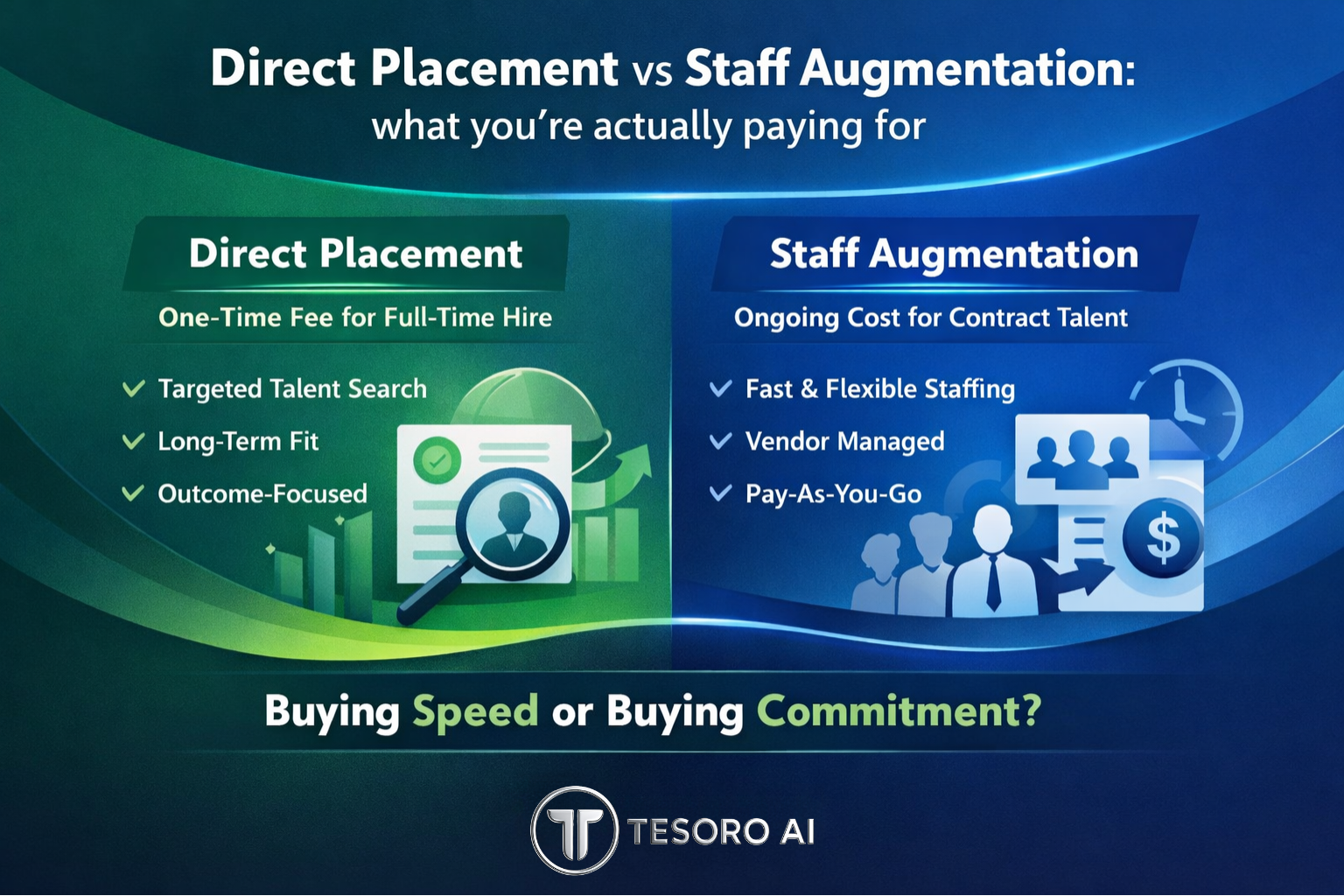
Every founder or CTO who starts hiring AI engineers eventually hits the same question: should we use direct placement or staff augmentation?
It sounds like a simple choice. One gives you a permanent hire. The other gives you flexible talent on demand. But the way these models are priced, structured, and incentivized creates real differences in cost, risk, and outcomes that most companies don’t fully understand until they’re already committed.
We see this confusion constantly at Tesoro AI. Teams come to us thinking they know which model they want, and by the end of our first conversation, they realize they were solving for the wrong variable. So let’s break down what you’re actually paying for in each model, where the hidden costs live, and how to make the right call for your stage and goals.
What Direct Placement Actually Looks Like
Direct placement means you’re hiring someone full-time onto your team. A recruiting partner sources, screens, and presents candidates. You interview, make an offer, and the engineer becomes your employee. The recruiter’s job ends once the placement is made.
The fee structure is typically a percentage of the hire’s first-year salary, usually ranging from 15% to 30% depending on the role’s seniority and difficulty. For a senior ML engineer in the U.S. at $200K total comp, that’s a $40K to $60K recruiting fee. For a LATAM-based engineer at $85K to $130K, the fee is proportionally lower, but the screening rigor should be the same.
What you’re paying for: permanent headcount, full integration into your team’s culture and codebase, long-term ownership of systems and models, and the recruiting partner’s sourcing and vetting work upfront.
What most people miss: the upfront fee is only part of the cost. You also carry the full burden of compensation, benefits, equity, onboarding, management, and retention risk. If the hire doesn’t work out in month three, you’re back to square one with the sunk cost of the fee, the salary burn, and the lost time. Many firms offer replacement guarantees, but the real cost of a failed placement is not the fee. It’s the months of roadmap delay.
What Staff Augmentation Actually Looks Like
Staff augmentation means you’re bringing in external talent that works as part of your team, but the employment relationship sits with the augmentation provider. You get the engineer. They handle payroll, compliance, contracts, and often onboarding infrastructure.
The fee structure here is usually a monthly or hourly rate that includes the engineer’s compensation plus a management margin. You don’t pay an upfront recruiting fee, but you pay a premium on the ongoing rate for the operational layer the provider handles.
What you’re paying for: speed, flexibility, and reduced operational overhead. You can scale up or down without the long-term commitment of a permanent hire. The provider handles compliance, payroll, and contracts, which matters especially when you’re working with international talent. At Tesoro AI, for example, we manage the full compliance and payroll layer for LATAM-based engineers so your team can focus entirely on the work.
What most people miss: staff augmentation is not “cheaper.” Over 12 to 18 months, the cumulative monthly cost often equals or exceeds what you would have paid through direct placement plus salary. The value proposition is not lower total cost. It’s speed to start, predictable monthly billing, reduced administrative burden, and the ability to exit without severance or legal complexity. If your planning horizon is six months, augmentation usually wins. If your planning horizon is two-plus years, direct placement often makes more sense financially.
The Real Cost Nobody Talks About
Here’s what gets lost in the placement vs augmentation debate: the most expensive outcome in AI hiring is not the model you choose. It’s the time you waste choosing wrong.
A $180K engineer hired three months late can cost more than a $250K engineer hired on time. That’s not motivational math. That’s runway math. If your burn rate is $150K per month and a critical AI role stays open for two months, you’ve already spent $300K in burn before the engineer writes a single line of code. The financial impact on that delay is the inability to hit a fundraising milestone or release a product ready that drives new revenue growth. Add the opportunity cost of delayed product milestones, and the gap between model A and model B starts to feel irrelevant compared to the gap between “hiring now” and “hiring eventually.”
This is why we frame cost as time-to-impact at Tesoro AI, not just compensation or recruiter fees. The question is not “Which model is cheaper?” The question is “Which model gets the right person into the seat fastest, with the least risk of failure?”
When Direct Placement Is the Right Call
Direct placement makes the most sense when the role is core to your long-term product strategy. If you’re hiring someone to own your ML systems, build and iterate on your core models, or lead your AI engineering function, you want that person on your team permanently. The investment in a direct hire pays off when retention is high and the engineer’s context compounds over time.
It also makes sense when you’ve already defined the role clearly, you have internal capacity to onboard and manage the person, and your compensation band is competitive enough to attract the seniority you need. For Series A and beyond companies with a clear technical roadmap, direct placement is often the foundation of a strong AI team.
When Staff Augmentation Is the Right Call
Staff augmentation wins when speed and flexibility matter more than permanence. If you’re running a short infrastructure build, testing a new AI capability before committing to a full team, or need to scale quickly for a specific project phase, augmentation gives you production-ready talent without the overhead of a permanent hire.
It’s also the better path when you’re hiring internationally and want to offer the non-compensation benefits of an employ, but you don’t have the legal entity or compliance infrastructure to employ someone directly in another country. LATAM talent, for example, can be integrated immediately through a staff augmentation model with the provider handling payroll, contracts, and local compliance. At Tesoro AI, we deliver full pods in under 30 days through this model, with bilingual engineers who are time-zone aligned and production-ready from day one.
And it’s worth noting: augmentation is not only for junior or temporary work. We place senior ML engineers, MLOps specialists, and data scientists through augmentation who stay embedded with client teams for 12 months or longer. The model is about flexibility in the employment structure, not a signal about the quality of the talent.
How to Decide: A Practical Framework
When companies ask us which model to choose, we walk them through four questions.
First, what’s your time horizon? If you need this role filled for two years or more and the person will own a critical system, lean toward direct placement. If the engagement is six to twelve months or project-scoped, staff augmentation is usually the smarter bet.
Second, how defined is the role? Direct placement requires a clear job scope, compensation band, and interview process. If you’re still figuring out what you need, augmentation lets you start working while the role takes shape. We’ve seen plenty of staff augmentation engagements convert to direct hires once the company understands exactly what they need.
Third, do you have the infrastructure to employ internationally? you can tap into LATAM engineers without a local entity. The local entity becomes important when you want to offer non-compensation benefits and structure similar to a domestic employee. This is when you want someone legally recognized as an employee versus an independent contractor.
Fourth, what does your budget actually optimize for? If you’re optimizing for lowest total cost over 24 months, direct placement usually wins. If you’re optimizing for speed, cash flow predictability, and operational simplicity, augmentation wins. Neither is inherently better. They solve different problems.
Why This Matters More for AI Roles
All of this is amplified when you’re hiring for AI and ML positions. These are not commodity roles. The difference between a senior ML engineer who can move models from proof-of-concept to production and one who looks great on paper but can’t ship is enormous. And the cost of getting it wrong is not just a bad hire. It’s a stalled product roadmap, burnt engineering cycles, and lost credibility with investors.
That’s why the recruiting model matters less than the recruiting partner. Whether you choose direct placement or staff augmentation, the quality of vetting, the depth of technical screening, and the alignment between the candidate and your actual needs are what determine whether the hire succeeds. At Tesoro AI, we screen for applied AI work, not credentials. We evaluate communication, cultural fit, and production mindset before a candidate ever reaches your calendar. That’s true in both models.
The honest answer to “Direct placement or staff augmentation?” is: it depends on your stage, your timeline, and what you’re really optimizing for. The wrong answer is the one you make without understanding what each model actually costs and what it actually delivers.
If you’re not sure which model fits your situation, that’s exactly the kind of conversation we have on a Fit Call. No commitment. No pressure. Just a clear-eyed look at what makes sense for your team.
Ready to figure out the right hiring model for your AI team? Book a Fit Call and we’ll help you map it out.