
Most AI hires don’t fail because the engineer lacked intelligence. They fail because the hiring process lacked signal.
We’ve seen the failure patterns repeat with painful consistency. Not at one company. Across dozens. The mistakes are almost always the same, and almost always preventable.
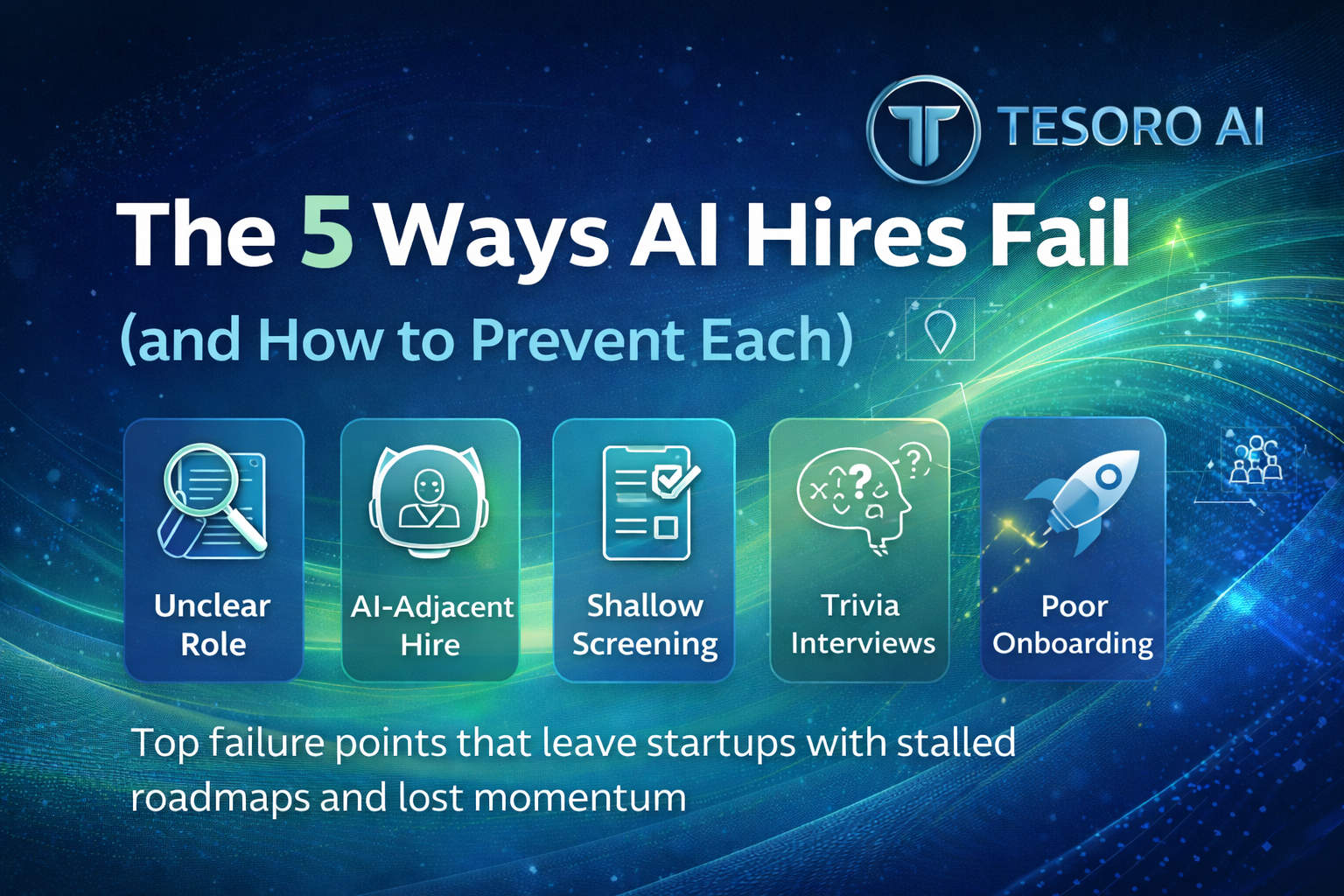
If you’re a founder, CTO, or engineering leader hiring AI talent this year, here are the five landmines we see most often, and what to do about each one.
1. The Role Was Never Actually Defined
This is the most common and most expensive mistake. A company decides they need “an AI person” and starts sourcing before they’ve answered basic questions: What does this person own? What does success look like in 90 days? Is this a research role, an applied ML role, or an infrastructure role?
Without clarity, you end up interviewing for the wrong profile, attracting candidates who expect a different job, and making a hire that feels misaligned within weeks.
How to prevent it: Before sourcing begins, define the role in terms of outcomes, not titles. What will this person ship? What stack will they touch? Who will they report to? At Tesoro AI, we work with clients to scope the role before we ever open a search. If the role isn’t defined, we won’t start sourcing blind.
2. The Interview Loop Tested Knowledge, Not Judgment
Asking a machine learning engineer to explain backpropagation tells you they took a course. It tells you nothing about how they handle tradeoffs when latency matters more than accuracy, or when training data is noisy and incomplete.
Trivia-based interviews are the equivalent of hiring a surgeon based on anatomy flashcards. What matters is whether they can operate.
How to prevent it: Replace knowledge checks with scenario-based evaluations. Ask: “Walk me through a time you had to choose between model accuracy and deployment speed.” Give them a live problem and watch them reason through it. At Tesoro AI, our technical screens are built around decision-making under constraints, because that’s what real AI work demands.
3. AI-Assisted Misrepresentation Went Undetected
This is the new frontier of hiring risk. Candidates are now using AI tools to generate polished resumes, fabricate portfolio descriptions, and prepare interview answers that sound flawless because they were literally written by a language model.
The signals that used to be reliable (clean resume formatting, relevant keywords, articulate answers) are now noise. A candidate can claim they “built a RAG pipeline” and produce a GitHub repo to prove it, when they actually followed a tutorial and dressed it up.
How to prevent it: Look for proof of ownership, not proof of exposure. Ask candidates to explain what broke, what they’d do differently, and what tradeoff they regret. Real builders have scars. At Tesoro AI, we use live reasoning exercises, real-world debugging scenarios, and “scar story” questions to separate practitioners from performers.
4. Culture Fit Was Treated as Optional
A brilliant ML engineer who thrives in a structured enterprise environment may drown in early-stage startup chaos. And vice versa. Culture mismatch isn’t about personality, it’s about whether the candidate will perform in your specific operational reality.
This is especially critical when hiring across borders. Latin American professionals are highly compatible with North American teams (time zone aligned, bilingual, culturally proximate) but there are still nuances. Communication styles can differ. Expectations around feedback directness may vary. Holiday calendars don’t always overlap.
How to prevent it: Map the candidate’s working pattern to your environment before the offer. At Tesoro AI, we screen for cadence fit, communication style, and ambiguity tolerance as part of every evaluation. We also prep both sides (the candidate and the client) to align expectations from day one.
5. Speed Overruled Rigor
You’ve been looking for three months. The board is asking about the AI roadmap. Your engineering team is burning out. Then a “pretty good” candidate appears and the temptation is overwhelming: just fill the seat.
Three months later, that hire is gone and you’re back at zero, except now you’ve lost six months of roadmap and the team’s trust in the hiring process.
How to prevent it: Speed and rigor aren’t opposites. The problem is that most hiring processes are too slow AND too sloppy. At Tesoro AI, we deliver our first curated shortlist in 7 days or less, with engineers vetted for technical depth, communication ability, and team fit. Full teams in under 30 days. Speed without compromise is possible when the screening system is built for it.
The Real Cost of Getting It Wrong
A mis-hire in an AI role isn’t just a recruiting expense. It’s a compounding problem: months of delayed product development, team morale erosion, and the opportunity cost of what could have been built with the right person.
For a company burning $150K per month, a two-month hiring delay costs $300K before the new hire’s salary even starts. Add in the cost of a failed placement (onboarding time, team disruption, starting over) and you’re looking at a multiple six-figure mistake.
That’s why we built Tesoro AI around signal, not volume. We’d rather send you three candidates who are right than thirty who look right.
What To Do Next
If any of these patterns sound familiar, you don’t need a bigger pipeline. You need a better process.
Start here: define the role in outcomes. Build your interview loop around judgment, not trivia. Screen for culture fit with intention. And don’t let urgency make you settle.
Ready to hire AI talent with a process built for signal? Book a Fit Call at tesoroai.com and we’ll walk you through how we approach your specific challenge.