
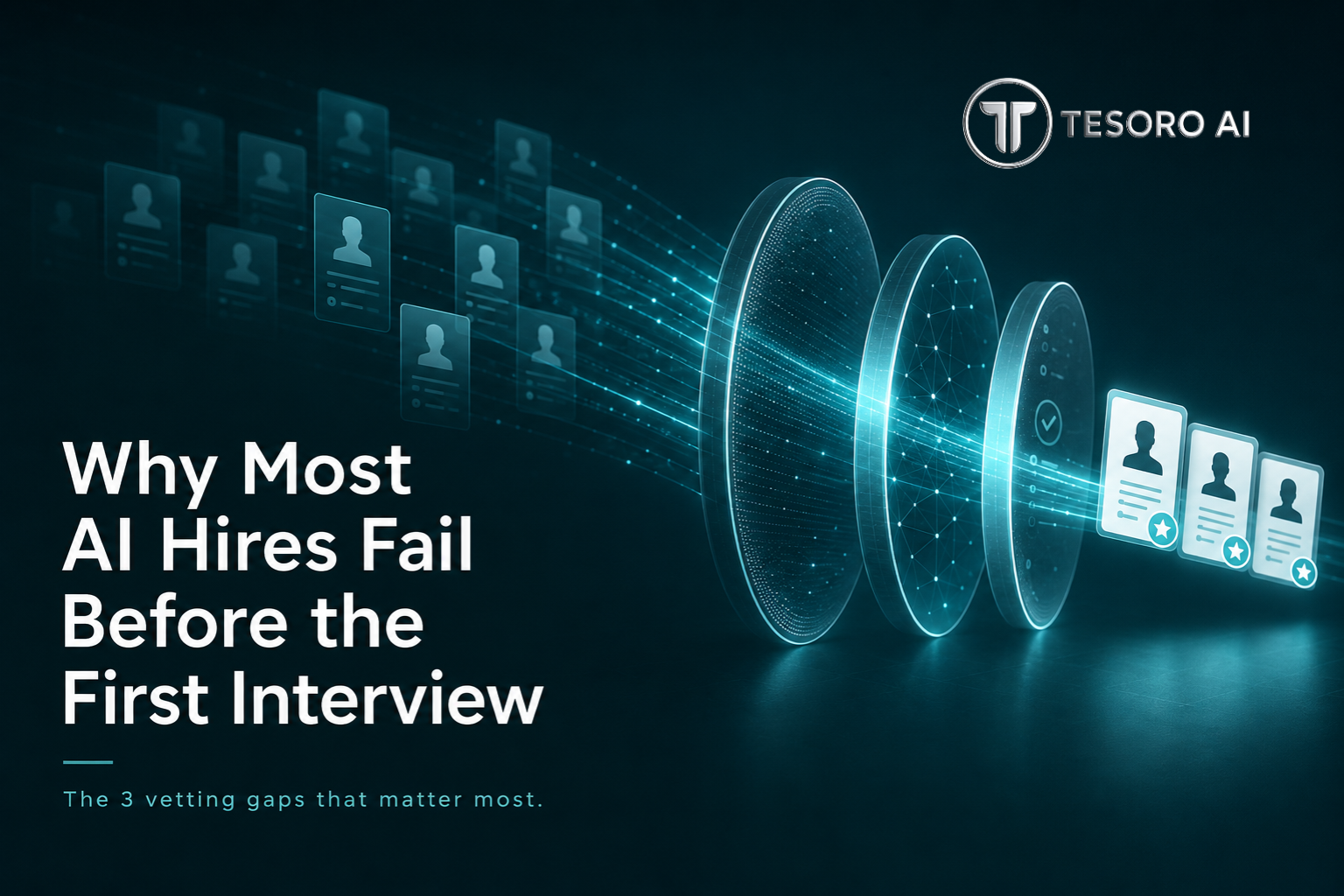
When an AI hire fails, the decision that doomed it was usually made before the first interview. The gaps that surface after Day 90 were almost always visible at the vetting stage, well before the candidate walked into the room.
When a hire does not work out, the post-implementation review usually fixates on the interview. Maybe the questions could have been sharper, the take-home could have caught the gap, or the reference check could have been more thorough. All of that may be true, and all of it misses the bigger pattern. The candidate should not have reached the interview.
Here is what we see across the AI roles we work on.
Three vetting gaps behind failed AI hires
A candidate looks strong on paper, performs well in conversation, and then cannot operate independently once hired. The shared cause is usually three vetting gaps stacked together, rather than a single missing skill.
The first gap is production experience. A candidate has worked on machine learning, but only inside notebooks, university projects, or internal proofs of concept. Production deployment is a different discipline. It requires familiarity with monitoring, versioning, latency constraints, and the operational ownership that comes with code in front of users. Resumes do not show this. Interviews rarely surface it. Targeted human review of what a candidate has actually shipped does.
The second gap is independent delivery. The candidate has shipped, but always inside a team where someone senior set the architecture, made the trade-off decisions, and handled the unknowns. Hiring teams looking for a force multiplier instead get a strong contributor who needs the same scaffolding the previous team provided.
The third gap is collaboration under ambiguity. AI work compresses requirements, data, and infrastructure into a single role faster than most companies expect. Candidates who cannot operate inside that ambiguity look fine in a structured interview and stall the moment the brief opens up.
Filtering before the interview is what changes the outcome
The companies that hire well for AI roles run fewer interviews against a smaller, sharper shortlist, not more rounds against a long one.
Tesoro’s vetting closes these three gaps before a shortlist lands. The work is human-led, conducted by recruiters with domain depth in AI. We review production history to confirm a candidate has shipped to live systems. We review how they operated in prior roles to confirm independent delivery. We talk through how a candidate has handled scope changes and ambiguous briefs in past work. None of it relies on automated scoring or third-party test platforms.
The first shortlist arrives in 7 days or less. Full pods are in place in under 30 days. Compliance, payroll, and contracts are handled end to end. The top 5% of LATAM AI engineers are the people in the funnel.
What to ask the recruiter you are working with right now
If you are evaluating an AI recruiting partner, the question that matters is what gets filtered out before you see anyone, not how many candidates they can send.
Three specific questions worth asking:
- How do you confirm production deployment experience, beyond resume claims?
- How do you confirm independent delivery in a candidate who has only worked on senior-led teams?
- What does your shortlist length look like, and why is that the right number?
A vague answer is itself information. The recruiters running real vetting can describe their filter in concrete terms. The ones who cannot are pushing the work of vetting onto your interview loop.
Better hires get built before the interview ever happens. The filter does the work. When the filter is weak, the interview cannot save the hire.
If you are hiring for AI roles this quarter and want to see what a sharper filter looks like before the interview, start a Fit Call with us: https://tesoroai.com/contact-form/