
The AI hires that fail rarely fail on day one. They clear the interview, sign the offer, and start strong. The trouble surfaces a quarter later, when the work has not landed and nobody can point to the moment it went wrong. By then the cost is already paid.
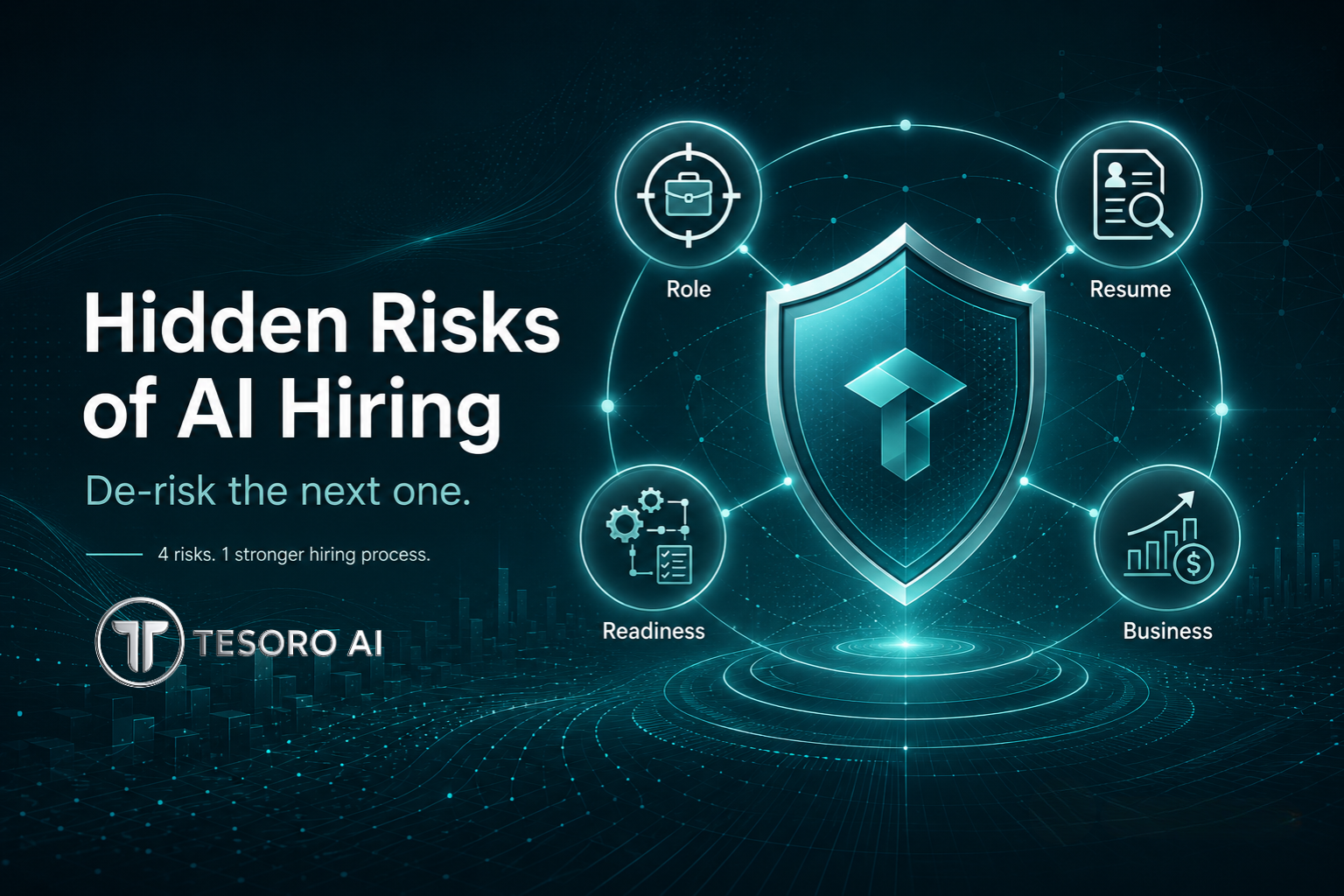
Most of that risk is avoidable. It tends to come from four places, and all four can be addressed before a single resume reaches your desk.
The risk starts before you post the role
The most expensive risk is the one teams create for themselves: an unclear role. “AI engineer” and “data scientist” describe very different jobs, and hiring one when the work needs the other produces a talented person who cannot move your roadmap. For example, a team that needs an MLOps engineer to put models into production will struggle with a research-leaning data scientist, however strong that person is on paper.
Define what the hire will actually own in the first 90 days before you write the job description. The role decides the hire. A vague role almost guarantees a mismatched one.
The risk hiding in the resume
AI is one of the easiest fields to look qualified in and one of the hardest to be qualified in. There is a whole category of candidate who has the vocabulary, the frameworks, and the certificates, and has never shipped a model that survived contact with production. They interview beautifully.
Keyword screening cannot catch this, because keyword screening is exactly what these candidates are built to pass. What separates a builder from a resume expert is human judgment from someone who has done the work and knows what real depth sounds like.
The risk that lands after the offer
Sometimes the candidate is right and the company is not ready. The data layer is further behind than anyone admitted in the interview, so the new hire spends the first month rebuilding pipelines instead of building models. Or the first project has no production owner, so the work sits in a notebook. Or there were never any written 90-day outcomes, so every direction feels like the wrong one.
Every one of these is a planning failure, and they sink good hires just as reliably as bad ones.
The risk to the business
A wrong hire in a critical AI role does not just cost a salary. For an early-stage company, it costs roadmap time you cannot recover, senior engineering hours spent mentoring or redirecting, and the quiet erosion of confidence when a board asks why the AI initiative slipped two quarters. The replacement fee is the smallest line in that equation.
How to de-risk the next hire
The pattern across every failure above is the same: the risk was knowable before the hire and got discovered after. Four moves close most of the gap, and none of them require a bigger budget. It starts with the role itself, deciding what the hire will own in their first 90 days before the job description gets written, so you are searching for the right person rather than the right keywords. From there, vet for the kind of hands-on depth that only shows once someone has shipped to production, the part a resume cannot fake. Then make sure the environment is ready for them, with a clear data layer and a named production owner from the start, and get the definition of success on paper so the hire and the team are working toward the same outcome from week one.
We screen the top 5% of LATAM AI engineers through human-led review against your actual role requirements, confirm bilingual capability and Americas time-zone alignment, and handle compliance, payroll, and onboarding so the role is set up to succeed before day one. The first shortlist reaches you in 7 days or less, full pods in under 30 days, at 50 to 70 percent lower cost than US onshore.
If you have an AI role open and want to pressure-test it against these four risks before you hire, start a Fit Call and we will walk through it with you.