
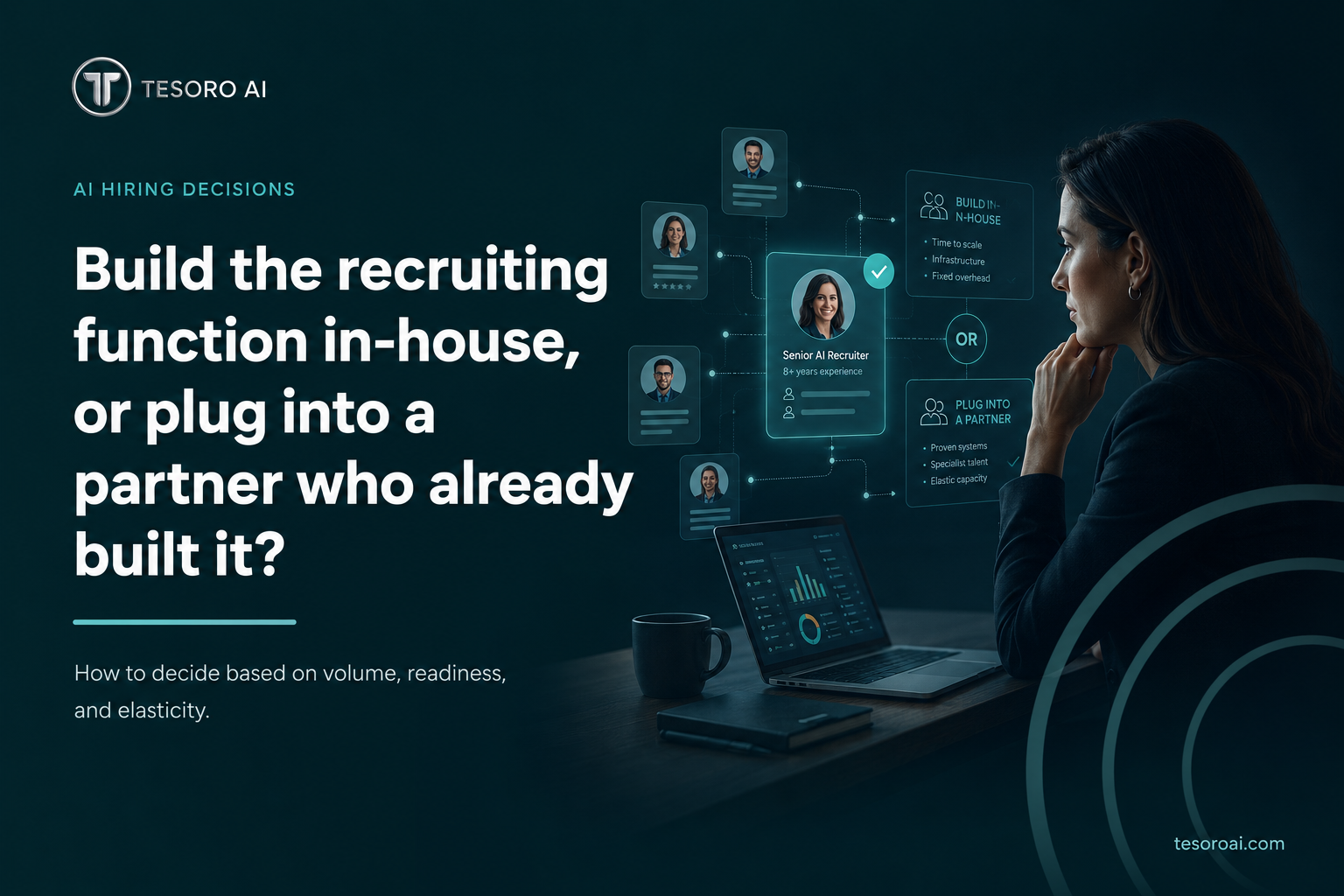
For AI roles, this decision usually gets made under pressure, for example, after a critical role has sat open for months and produced only a couple of phone screens. The frustrating part is that both models work. They answer different questions, and the cost of choosing the wrong one lands as an empty seat on the roadmap, typically months before anyone names the cause.
What in-house recruiting actually buys you
An internal recruiter brings control and context. They sit inside your culture, learn each team’s quirks, and carry your story to every candidate. When hiring volume is steady across many roles, that investment compounds into a durable function.
The economics are real when the function stays busy. A recruiter who keeps a full slate of roles earns back the salary and the ramp. The question is whether your AI roles arrive at that volume, or in ones and twos that never let the function find its rhythm.
AI roles stress the model. An internal generalist rarely arrives with a network of ML engineers, data engineers, and applied researchers, so the pipeline gets built from scratch. They have to find new sourcing channels, test outreach, and learn unfamiliar talent markets while the role stays open. That ramp takes months, and the seat stays empty while it does. And when hiring slows, the fixed cost of the function stays on the books.
What a specialized partner already has
A specialized AI recruiting partner starts from a running engine. The network exists, the screening is run by people who work these roles every week, and the effort scales up when you have five open roles and back down when you have none.
At Tesoro AI, for example, that engine is built around LATAM AI talent. We run human-led screening against your specific role requirements, confirm bilingual capability and Americas time-zone alignment, and handle compliance, payroll, contracts, and onboarding end to end. The first shortlist arrives in 7 days or less, and full pods in under 30 days.
The judgment error that distorts the decision
The comparison usually gets reduced to headcount math: a recruiter salary against a partner’s fee. That math hides the variable that actually decides outcomes, which is pipeline readiness.
A useful test: how many qualified AI candidates can your current process put in front of the team in the next two weeks? If the honest answer is close to zero, every additional week spent building in-house capability is paid for in roadmap delay. A fee comparison only makes sense between two pipelines that are equally ready.
Until the pipelines are even, the real comparison is between capability you have today and capability you are still building, and that gap is measured in weeks the roadmap cannot spend.
How to decide
In practice, many scaling companies run both. A small internal function owns coordination, culture fit, and the steady roles. A specialized partner takes the hard-to-fill roles, the new regions, and the surges. Each side does the work it is structurally built for.
Three questions settle which roles deserve which engine:
- Volume. Is hiring steady across many roles, where an internal function compounds, or concentrated in a few critical, niche roles, where a partner’s existing network wins?
- Readiness. Can your pipeline produce qualified AI candidates this month, or next quarter?
- Flexibility. What happens to the function, and its cost, when hiring pauses?
Clear answers settle the build-or-partner question faster than any fee negotiation.
If the role on your desk is a core AI hire and the internal pipeline is still warming up, that is the situation we built for. We focus on the top 5% of LATAM AI engineers, then run human-led screening against your role requirements, at 50 to 70 percent lower cost than US onshore, with the compliance and onboarding layer already handled.
Bring us the role that has been open the longest. One conversation is usually enough to tell whether our pipeline reaches the people yours cannot. Start a Fit Call