
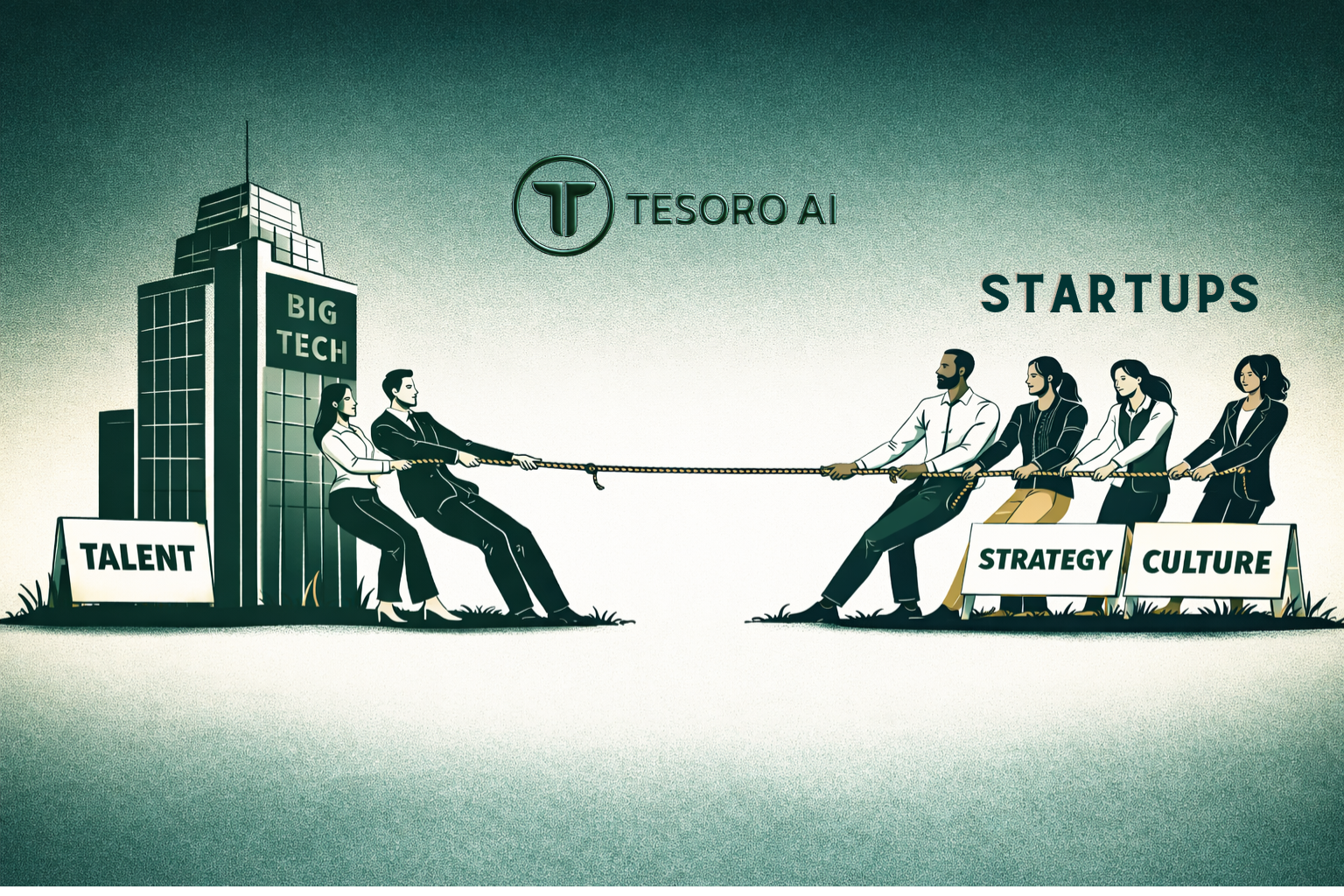
Some founders believe they don’t compete with Big Tech for talent. That belief is expensive.
Even if your company is not directly bidding against Google or Meta for the same candidate, Big Tech shapes the AI hiring market in ways that affect every company trying to build an AI team. They anchor compensation expectations. They control the supply of available talent. And they set a definition of “qualified” that most startups adopt without questioning whether it actually predicts success.
Understanding how this distortion works is the first step to building an AI team without getting trapped by it.
The Compensation Anchor
The most visible distortion Big Tech creates is in compensation. Google, Meta, Netflix, and Amazon set salary floors for AI roles that most startups and growth-stage companies simply cannot match. A senior ML engineer at a large tech company can earn $350K to $500K or more in total compensation when you include base salary, bonuses, and equity. According to the U.S. Bureau of Labor Statistics, median annual pay for computer and information research scientists reached $145,080 in 2023, but that median masks the top end of the distribution where Big Tech operates.
For startups, this creates a structural disadvantage. They do not produce enough cash flow to compete on a compensation basis. And even when they find talent in smaller markets across North America, retention becomes the next challenge. This is not a hypothetical problem. A 2024 analysis by Revelio Labs found that AI-related roles at the largest tech firms carried compensation premiums of 30% to 50% over equivalent positions at mid-market companies. That premium does not just affect who you can hire. It shapes who stays.
Talent Hoarding Is Real, and the Data Backs It Up
“Talent hoarding” sounds dramatic until you see the numbers. The concept is straightforward: if you have the balance sheet to hire as many people with a rare skillset as you can, you deprive your competitors of access to that talent. It is, as Darius Gant describes it, an arms race.
The evidence supports this. Stanford’s 2024 AI Index Report documented that between 2019 and 2023, the concentration of AI talent at the top 10 technology companies increased significantly, even as total AI job postings across the broader market declined. Big Tech was not just hiring for immediate needs. They were stockpiling talent to maintain competitive moats.
There have also been credible reports of large tech firms retaining technical recruiters at scale specifically to prevent those recruiters from helping competitors source AI talent. The strategy is not subtle. If you control the supply of both the talent and the people who find that talent, you control the market.
For startups, the practical impact is that the available pool of senior AI engineers who are both qualified and reachable is significantly smaller than the total number of people with AI skills. The talent exists. It is just not available through conventional channels.
The Credential Trap: Why the Big Tech Playbook Fails for Startups
Beyond compensation and supply, Big Tech distorts how companies define what a “qualified” AI candidate looks like. The historical playbook is familiar: hire from Ivy League universities, prioritize PhDs, recruit from the same target schools that investment banks and consulting firms have used for decades.
This approach made sense in a world where AI skills were developed exclusively inside academic institutions. But that world does not exist anymore. The newness of AI and the way AI skills are developed relative to traditional disciplines breaks all the rules.
A 2023 study from GitHub found that over 70% of active AI/ML contributors on the platform were self-taught or had learned through online programs, not through traditional degree programs. Platforms like Coursera, fast.ai, and open-source communities have democratized access to the knowledge required to build production AI systems. That opened the talent pool globally, giving many more people access to the frontier, regardless of where they went to school.
When startups copy Big Tech’s credentialing playbook, they artificially narrow their talent pool at the exact moment they need it to be wide. A PhD from Stanford does not guarantee someone can move an ML model from proof-of-concept to production in a resource-constrained environment. And a self-taught engineer from São Paulo who has shipped three production models may be exactly what your team needs.
What Actually Predicts Success in a Startup AI Role
If credentials are not the primary signal, what is? The answer is a set of traits that have nothing to do with pedigree and everything to do with how someone operates.
- Creativity. Most of the problems startups are trying to solve with AI have not been solved before. You need people who can think beyond existing frameworks and design novel approaches, not just replicate what they learned in a course.
- Natural curiosity. The AI field moves so fast that anyone who relies only on what they already know will fall behind within a year. You want people who are diving into the latest research, experimenting with new tools, and staying on the frontier by default.
- Proof of work. Naturally curious people tend to have their own projects. They have artifacts they can show: side projects, open-source contributions, portfolio pieces, Kaggle results, or production systems they built. This matters more than any line on a resume.
- Delivery mindset. Can this person describe doing real work under real constraints? In startups, there is not always time, not always budget, and the technology needs to work in production, not just in a notebook. When a candidate can talk about deploying systems with limitations and trade-offs, you are looking at someone who can deliver.
- Comfort with ambiguity. Startups do not have a playbook. They cannot tell a new hire exactly what tomorrow looks like. The person who thrives in this environment has a mentality that says: I finished this at a level of quality I believe is ready to present. What’s next? That is a mindset. It has nothing to do with which school is on their diploma.
This is backed by research. A 2023 LinkedIn Workforce Report found that skills-based hiring increased by 20% year-over-year among high-growth tech companies, while reliance on degree requirements declined for the third consecutive year. The market is catching up to what effective hiring managers already know: performance is about what someone can do, not where they learned to do it.
Why Big Tech Interview Skills Don’t Translate to Startup Performance
There is a persistent assumption that if someone can pass a Big Tech interview, they will perform well anywhere. That assumption is wrong.
Big Tech interviews are optimized for Big Tech roles. The daily reality of working inside a large organization is fundamentally different from working in a startup. In a startup, a data scientist might spend two weeks organizing and labeling data before they get to do any modeling. That is the reality of working with real constraints. It is a get-it-done, by-any-means-necessary environment.
In Big Tech, roles are more defined. The infrastructure is built. The processes are documented. Someone who excelled in that structure may find the startup environment chaotic, unstructured, and frustrating. And someone who grew up in the more dynamic world of a startup might find Big Tech boring for the exact same reasons.
The practical takeaway for hiring managers: do not use Big Tech interview performance as a proxy for startup readiness. Screen for how someone operates, not where they have operated.
The Hiring Mistake Teams Keep Making
The single biggest mistake teams make because of Big Tech’s influence is over-indexing on brand names on resumes.
Inside every large organization, whether it is Big Tech, Big Four accounting, or a Fortune 500 company, there are star players and there are people who sit on the bench. There are people who work on large, high-impact projects and people who are not staffed on meaningful work for long stretches. The difference in experience between those two types of people is enormous, even though their resumes look identical.
A brand-name company on a resume tells you where someone has been. It does not tell you what they actually did, how much autonomy they had, or whether they can replicate that performance in an environment with no playbook and no safety net. Structure may have enabled their success at the previous company. Without that structure, the results may not follow.
Harvard Business Review published research in 2022 showing that external hires from prestigious employers underperformed internal candidates and non-prestige external hires during their first two years. The brand premium on the resume did not translate to better outcomes. It translated to higher expectations and, in many cases, higher turnover.
How Startups Actually Win the Talent War
If you cannot outspend Big Tech, you have to outcompete on the intangibles. And the good news is that startups have genuine structural advantages that Big Tech cannot replicate.
- Mission. The thing that differentiates the startup environment is the mission of the organization. People who are drawn to AI tend to be naturally curious. They want to advance their skillset. And in a startup, there are more opportunities to do different types of work, take on new challenges, and see the direct impact of their contributions. In Big Tech, you run the same processes each day and your work does not move the needle the same way.
- Growth velocity. In a startup, an AI engineer exercises judgment every day. They are making decisions about architecture, tools, trade-offs, and priorities in ways that simply do not happen inside a larger machine. For people focused on growing their skillset, this is the most valuable currency there is.
- Alignment over compensation. The key is to find talent where your company’s mission, growth opportunity, or career path resonates with their personal ambition. Whether that’s a personal mission, a career objective, or a financial goal, if your company represents an opportunity for them to fulfill something bigger, you will get someone who comes to work every day ready to build. That person stays not because you matched Big Tech’s comp package, but because your company is a vehicle to a bigger dream.
A 2024 survey by Hired.com found that 62% of AI/ML engineers ranked “impact of work” and “learning opportunities” above total compensation when evaluating startup roles. The data confirms what good founders already sense: you do not need to win the salary war. You need to win the story.
A Practical Playbook for Startups Hiring AI Talent Today
If you are a startup building an AI team, here is how to stop playing by Big Tech’s rules and start hiring on your terms.
- Redefine what “qualified” means. Drop the target-school mentality. Screen for creativity, curiosity, proof of work, and delivery mindset. Test for these in your interview process through real-world scenarios, portfolio reviews, and constraint-based problem solving.
- Build your interview process around startup reality. Test for ambiguity tolerance, resourcefulness, and the ability to operate with imperfect information. Ask candidates to describe work they did under real constraints. The person who lights up when talking about shipping with limitations is the one you want.
- Lead with your story, not your comp band. Candidates are getting smarter about equity. Many have seen it turn into nothing. So you need to win on the intangibles: mission, learning velocity, impact, and the opportunity to grow faster than they would inside a larger organization.
- Expand your talent pool geographically. If Big Tech dominates the U.S. AI talent market, look where they are not looking. LATAM, for example, has a growing base of bilingual, technically strong AI engineers who are time-zone aligned and production-ready. At Tesoro AI, we source from this pool specifically because it gives our clients access to senior-level talent that Big Tech is not actively hoarding.
- Think independently. As Darius puts it: don’t look at the headlines and believe you need to follow the same route as Big Tech. The rules they play by are designed for their balance sheet, their structure, and their goals. Your rules should be designed for yours.
Big Tech will continue to distort the AI talent market. That is not going to change. What can change is whether you let that distortion dictate how you hire.
The companies that build the best AI teams are not the ones that outspend Big Tech. They are the ones that think differently about what talent actually means, where to find it, and how to keep it.
If your AI hiring process is still shaped by Big Tech’s playbook, let’s fix that. Book a Fit Call and we’ll show you what a smarter approach looks like.
👉 Link to the full “Big Tech Distorts the AI Talent Market” video with Darius Gant.
Sources Referenced:
- U.S. Bureau of Labor Statistics, Occupational Outlook Handbook: Computer and Information Research Scientists, 2023 data
- Revelio Labs, AI Talent Compensation Analysis, 2024
- Stanford University, 2024 AI Index Report (HAI)
- GitHub, Octocat State of AI/ML Survey, 2023
- LinkedIn Workforce Report: Skills-Based Hiring Trends, 2023
- Harvard Business Review, “Why External Hires Underperform,” 2022
- Hired.com, State of AI/ML Engineering Talent Report, 2024