
The first AI hiring budget usually fits on one line: salary, recruiter fee, onboarding. A quarter later, the real cost looks nothing like that line.
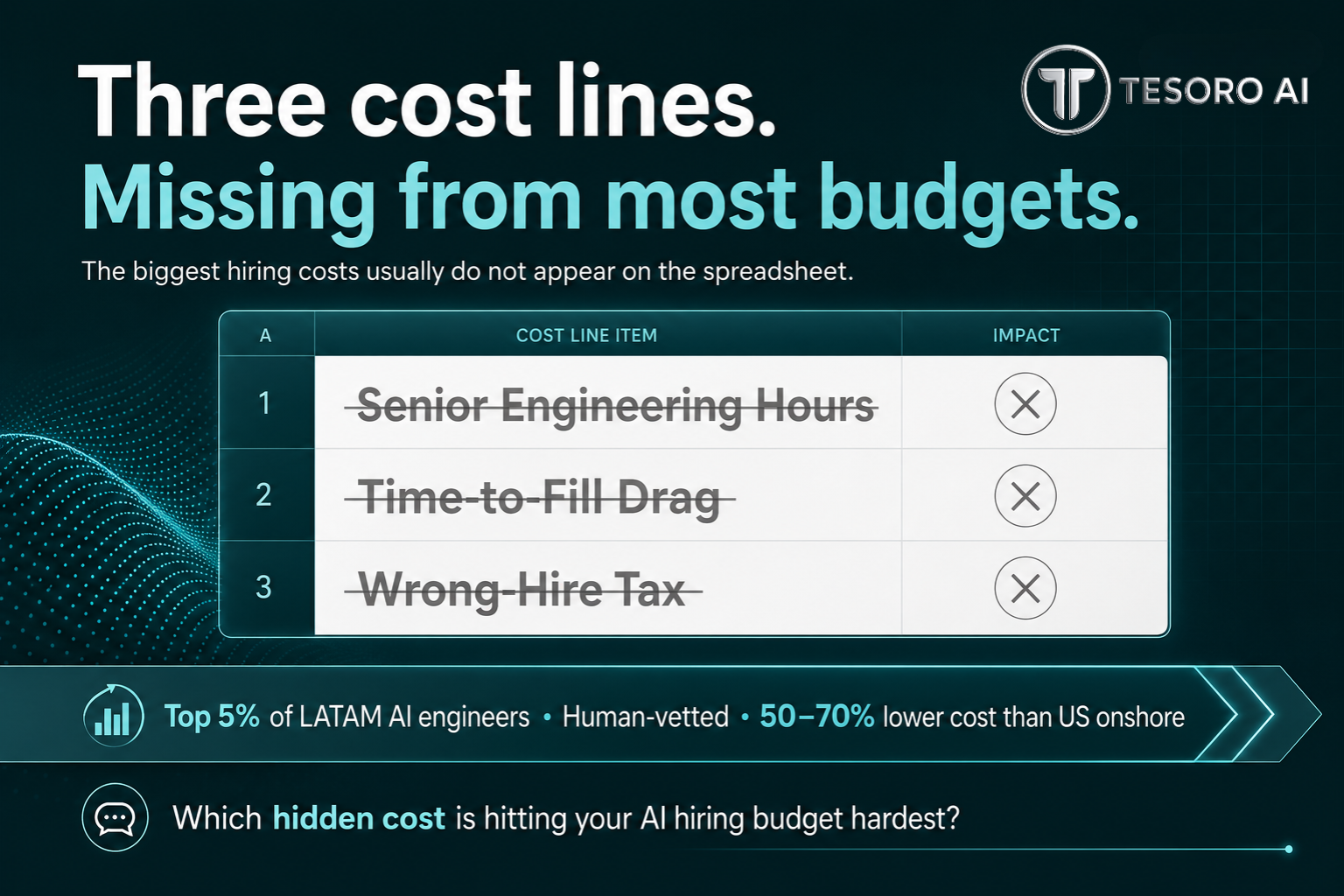
The numbers that get missed are not on the cost-of-living side. They sit in three places a budget rarely names: the time your own team loses to the search, the cost of the seat staying empty, and the price of getting the hire wrong. These absorb engineering capacity quietly, and they only surface when the quarter closes and velocity is behind.
Here is where the spreadsheet misses.
Hidden cost one: the hours your senior team loses
Every AI search pulls time from the people who can least afford to give it. The hiring manager runs intake calls, your senior engineers spend hours on technical conversations and take-home reviews, and the CTO gets pulled in to judge the architectural reasoning of the finalists.
For one role, in our experience, that quietly adds up to a meaningful slice of senior engineering time. Run three AI searches in parallel and you are spending a real share of your senior bandwidth for the quarter. It never shows on the recruiting line, because it is already paid as salary. It shows up later, as the features that did not ship.
Hidden cost two: the cost of an open seat compounds
An open AI role gets more expensive every week it stays open. The team carrying the extra work slows down. Decisions the missing engineer would have owned sit unmade. Other roles that depend on their part of the architecture wait on it.
A delay of a month or two on a senior AI hire tends to ripple through the roadmap well past the time the seat sat empty. The recruiter fee is fixed. The cost of the drift is not.
Hidden cost three: the wrong-hire tax
A hire who clears the interview loop but cannot operate independently at the level the role needs does more than leave a gap when they exit. They need mentorship before they are productive, they soak up code review they should not need, and the rework lands on someone else after they go.
Add replacement, ramp, and lost velocity, and the full cost of a wrong AI hire routinely dwarfs the recruiter fee that placed them. The fee is the smallest number in that equation.
How the right structure takes those three lines off your team
The right recruiting model does not make hiring free. It moves the cost off your team and onto the recruiter, where it belongs.
Tesoro AI’s vetting is human-led, run by recruiters with real depth in AI roles. We review what a candidate has actually shipped, how they worked on prior teams, and how they respond when the scope changes. By the time a shortlist reaches you it is short, a few strong names who have cleared that review, so your interview loop becomes a decision rather than a second screening pass. The first shortlist arrives in 7 days or less, full pods land in under 30 days, and compliance, payroll, and contracts are handled on our side.
The people in that funnel are the top 5% of LATAM AI engineers, at 50 to 70 percent lower cost than US onshore. That is the salary side, and it matters. The bigger return is the three hidden lines coming off your team’s calendar.
A simple test before you sign off on the next AI hiring budget
Before the search starts, model three questions:
- How many senior engineering hours will this role consume across the interview loop, and which features get displaced to pay for them?
- What does it cost, in roadmap and velocity terms, if the role stays open one extra month?
- What does replacement look like if the first hire does not work out by month six?
If the answers are vague, the budget is incomplete.
The salary line is the easy number. The three hidden lines are where the AI hiring budget actually lives. If you want to see what a shortlist looks like when the screening happens before it reaches you, start a Fit Call.